Inside Sagrada Familia: Interior, Stained Glass & Ceiling
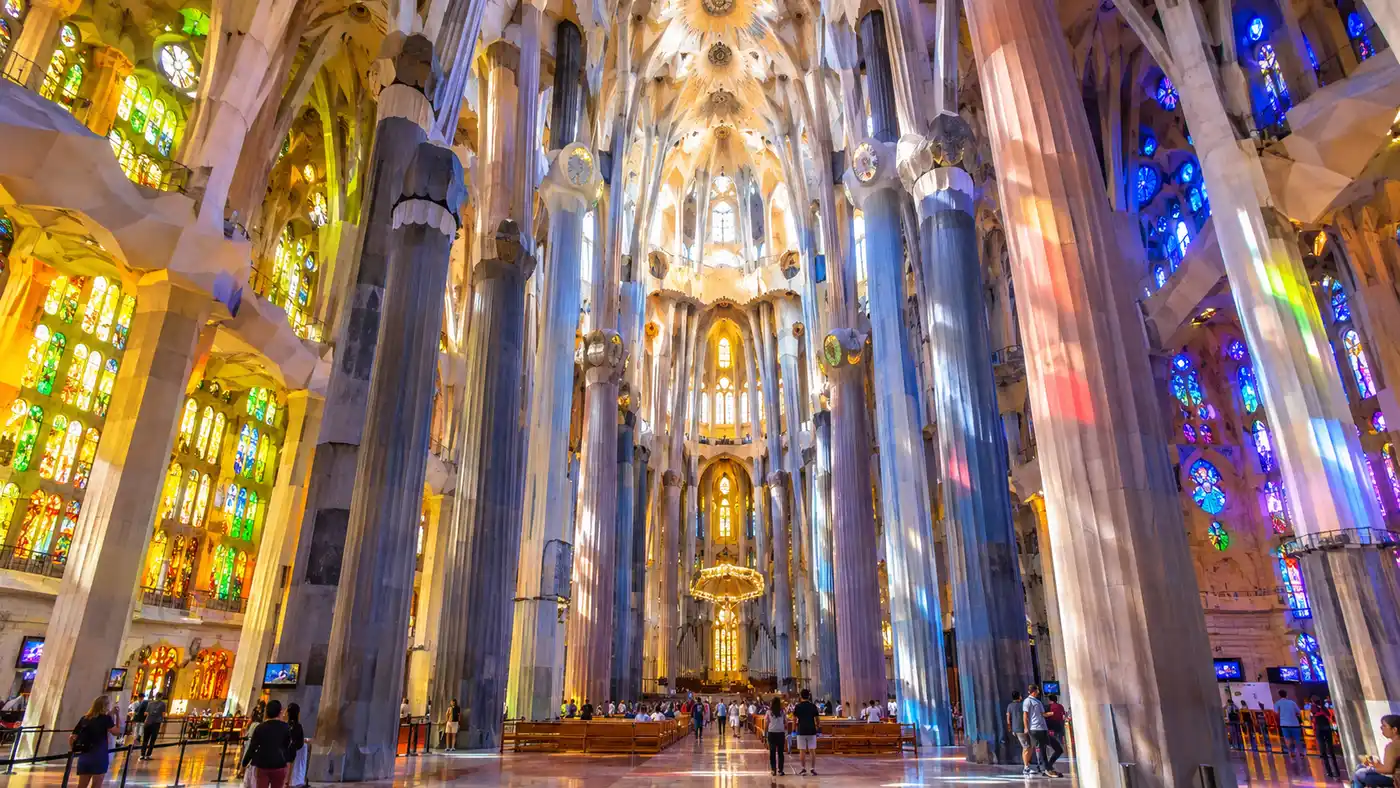
Nothing really prepares you for stepping across that threshold. Most visitors spend twenty minutes on the pavement outside craning their necks at the stone turtles and weeping biblical figures carved into the Nativity facade, convinced they grasp Gaudí's peculiar genius. Then you pass through the metal detectors, hand over your ticket, and walk through the portal. Seeing the sagrada familia inside completely shatters whatever expectations you had built up from postcards. It does not feel like stone and mortar. It feels like walking into the ribcage of an ancient, sunlit organism or standing under a petrified forest canopy on another planet.
Gaudí intended the basilica to operate as a space of quiet communal worship, but he also designed it as an open love letter to the natural world. The interior of Sagrada Familia discards nearly every Gothic cliché you picked up touring cathedrals across Europe. There are no dark vaulted corners smelling of damp moss, no gloomy side chapels drowned in heavy gilt, and no massive stone blocks blocking your sightlines. You find soaring branching pillars, kaleidoscopic walls of glass, and mathematical geometries that look like they belong in a geometry textbook from the twenty-second century. If you are planning your first trip, this guide covers what you will actually see inside the church, how the daylight shifts across the stone, and where to look so you do not miss the smaller quirks Gaudí hid in plain view.
Book your sagrada familia experience:
The Forest Canopy: Columns and the Sagrada Familia Ceiling
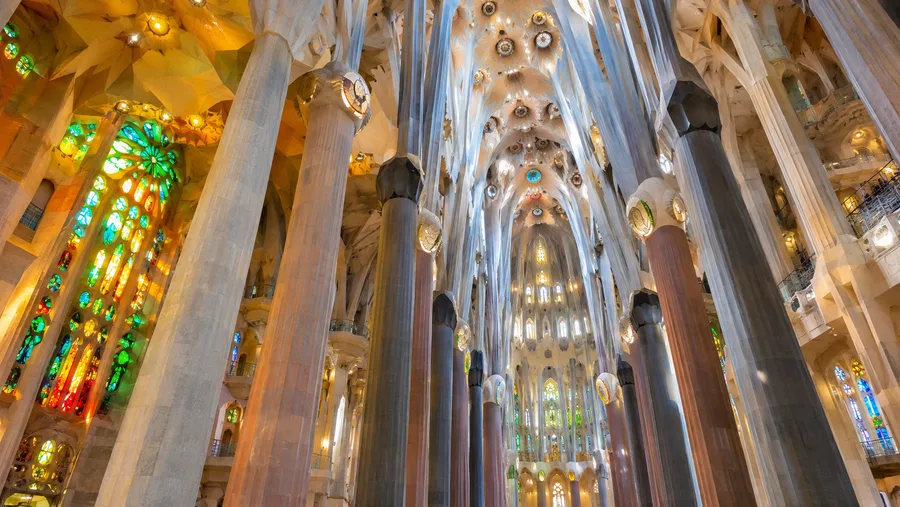
Look straight up the second you walk through the doors. Everyone does it. Your neck will probably ache by the time you leave, and you will not care. The ceiling of Sagrada Familia hangs roughly 45 meters above the central nave floor, held aloft by a dense grid of stone pillars that branch outward like tree limbs as they reach the roof. Gaudí hated straight lines because he claimed they did not exist in nature. Trees do not grow at rigid right angles, so he refused to build rigid columns.
These columns do something strange as they climb. If you follow one with your eye from floor to ceiling, you will notice the base starts as a polygon with fluted ridges, shifts into an octagon, turns into a smooth circle, and finally splits into branches that cradle the ceiling vaults. To handle the monstrous weight of the building without needing external flying buttresses - which Gaudí dismissively called stone crutches - he picked four distinct types of stone from across the world. The hardest, densest materials anchor the central crossing where the weight is heaviest, while lighter sandstone sits out along the perimeter aisles.
| Stone Material | Quarry Origin | Color Tone | Structural Role |
|---|---|---|---|
| Red Porphyry | Iran | Warm red-brown | The four main crossing pillars bearing the tower weight |
| Basalt | Castellfollit, Catalonia | Dark charcoal grey | Transept and high-load apse supports |
| Granite | Galicia, Spain | Mottled light grey | Central nave secondary columns |
| Sandstone | Montjuïc, Barcelona | Pale golden ochre | Outer walls and low-load side chapels |
Between the tree branches, the ceiling of the Sagrada Familia is punctured by open geometric patterns called hyperboloids. They look like giant stone sunflowers or starry funnels. Small discs of green and gold Venetian glass sit recessed inside these starbursts, reflecting ambient sunlight back toward the floor. When natural daylight pours down through the gaps in the roof vaults, it imitates the exact dappled sunlight you get while walking through a thick beech grove at noon.
Light and Color: The Sagrada Familia Stained Glass Windows
If the ceiling supplies the forest skeleton, the stained glass Sagrada Familia inside supplies the breath. Most historic cathedrals put narrative scenes on their windows, showing saints holding tools of martyrdom or Kings looking solemn in leaded glass frames. Gaudí chose an abstract path. He left broad notes on the light balance before his death in 1926, but the actual glass you see today was created by Catalan artist Joan Vila-Grau starting in the late 1990s.
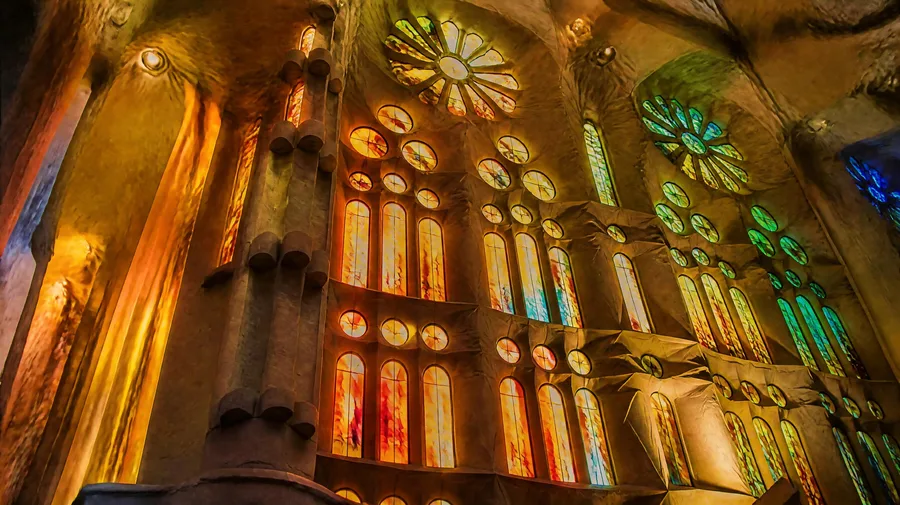
Vila-Grau followed Gaudí's chromatic scheme to the letter. The eastern windows - on the Nativity side - feature deep ocean blues, mint greens, and cold aquamarines. This is where the morning sun breaks through. It represents the dawn, water, hope, and the birth of Christ. As the earth turns, the sun travels across the southern transept and hits the western facade, the Passion side. Here, the glass turns into an explosion of fiery vermilion, safety-vest orange, bright yellow, and blood red. By late afternoon, the nave does not just catch colored light; it physically drowns in it.
Pro tip: Book your entry time between 4:30 PM and 6:00 PM during autumn or spring. The sun sits lower in the sky and blasts straight through the Passion windows, projecting giant crimson and amber squares across the floor and columns.
I stood near the central aisle around 5:15 PM on a Tuesday in October, and the entire marble pavement was glowing like hot iron. People stopped walking. The security guards had to gently prod visitors out of the aisles because dozens of travelers simply froze mid-step, watching the red light climb up a porphyry column. It felt less like being in a tourist hotspot and more like witnessing a slow sunset in a canyon.
The glass changes from bottom to top, too. The most saturated, intense colors sit down at eye level where you can see the deep pigments. As the glass panes climb higher toward the vaulting, the colored tiles give way to transparent, textured glass. Gaudí wanted the highest points of the church to flood with pure white light so the intricate ceiling carvings would remain crisp and readable from the ground.
The Snail Shells: The Sagrada Familia Spiral Staircase
Tucked into the stone towers flanking the nave are some of the most photographed stairs in Europe. If you buy a ticket that includes access to the towers, you will ride an elevator to the high bridges connecting the spires, take in the panorama across Barcelona to the Mediterranean, and then make your descent on foot. This brings you face-to-face with the la Sagrada Familia spiral staircase.
Gaudí modeled these stairs directly on the geometry of marine snails, specifically the empty chambered nautilus shell. There is no central support pole. Instead, the stone steps are cantilevered directly out from the circular outer wall, spiraling down into an empty, dizzying vertical void. Looking down from the top landing is enough to make your stomach drop into your shoes. The repeating curve forms a geometric vortex of pale stone that seems to pull your gaze downward into infinite darkness.
If you are trying to decide which spires to climb, read our breakdown of the Sagrada Familia towers before locking in your reservation. Each tower features a slightly different descent, and the views out over the city vary significantly depending on whether you choose the Nativity or the Passion side.
Note: Anyone dealing with serious vertigo, claustrophobia, or knee issues should skip walking down the tower stairs. There is no elevator down from the top platform, meaning you must tackle roughly 400 spiral steps inside a tight, enclosed stone shaft.
Book your sagrada familia experience:
Look Closer: The Altar, Baldachin, and the Crypt Beneath
The central altar feels surprisingly modest considering the sheer volume of the room around it. Positioned at the end of the main aisle, it sits elevated on a stone platform framed by the curved apse columns. Above the simple stone block hangs the baldachin, a heptagonal canopy designed by architect Jordi Bonet. It looks like a floating parchment lantern draped in trailing vines, ears of golden wheat, and glass grape clusters, symbolizing the Eucharist bread and wine. Suspended beneath it is a life-sized bronze sculpture of Jesus on the cross, lit from above by fifty tiny brass lamps.
Directly behind the altar stands the massive pipe organ, featuring 1,492 pipes that fill the basilica during Sunday services. The acoustics inside la Sagrada Familia church are strange. Because the ceiling vaults are broken up into irregular geometric shapes rather than flat domes, sound does not echo in the harsh, hollow way it does in Notre-Dame or St. Peter's. Voices scatter softly into the upper branches.
You can also glimpse the original neo-Gothic crypt from the main nave. The crypt was the very first part of the church built under the original architect, Francisco de Paula del Villar, before Gaudí took over the project in 1883. It sits several meters below the modern floor. If you walk behind the choir near the apse, look down through the heavy bronze grates in the floor. You can see the vaulting of the subterranean chapel where Gaudí himself lies buried inside a simple stone tomb.
- The bronze Glory doors: inscribed with the complete Lord's Prayer in fifty different languages, with the Catalan text raised in polished relief right where your fingers naturally brush the handle.
- Evangelist pillar markers: four glowing translucent glass shields set into the thickest porphyry columns, displaying winged symbols for Matthew, Mark, Luke, and John.
- Choir gallery platforms: soaring stepped stone tiers wrapped around the apse perimeter, designed to hold up to 1,000 choristers singing down into the nave.
- Apse stone reptiles: carved stone lizards, frogs, and snakes crawling downward along the exterior apse walls inside the lightwells, symbolizing earthly evil fleeing the light of the altar.
How to Plan Your Visit to See the Sagrada Familia Inside
Walking into the basilica without a plan usually means spending half your time dodging selfie sticks or getting corralled by tour groups. The entrance system is strictly timed, and security operates much like an international airport gate. Buying your pass ahead of time is completely non-negotiable; tickets routinely sell out two weeks in advance during high season. Check our comprehensive Sagrada Familia tickets guide to figure out which entry tier matches your budget and schedule.
Give yourself at least 75 minutes inside the main floor. You do not want to rush this. Walk down the center nave first, find an open bench near the side aisles, sit down, and let your eyes adjust to the sheer scale of the place. Photography inside the Sagrada Familia is permitted, but leave bulky tripods, monopods, and massive camera rigs back at your hotel because guards will turn them away at the bag check.
- Best time for light: enter between 9:00 AM and 10:30 AM for cold marine blues, or 4:00 PM and 6:30 PM for fiery reds and golds.
- Audio guide requirement: download the official Sagrada Família app onto your phone before leaving your hotel; the basilica Wi-Fi struggles under the crowd load.
- Dress code rules: shoulders must be covered, shorts and skirts must hit mid-thigh, and no hats or transparent shirts are permitted past the door.
- Quiet areas: the Blessed Sacrament Chapel near the eastern wall is reserved exclusively for prayer and reflection, offering an escape from the crowd noise.
A lot of travelers ask if paying the entry fee just to see the inside of Sagrada Familia Barcelona is worth it, especially if they have already snapped twenty photos of the facade from the public park across the pond. Honestly, skipping the interior is the biggest mistake you can make in Catalonia. The exterior is brilliant, but it is the outside shell of an idea. The inside is the idea fully realized.
Frequently Asked Questions about sagrada familia inside
How long should I spend inside the Sagrada Familia?
Most travelers spend between 75 and 90 minutes exploring the main floor, the apse, and the small side chapels. If you also hold a ticket to climb one of the towers or want to spend time downstairs in the architectural museum, plan for two to two and a half hours total.
Can you take photos inside the Sagrada Familia?
Yes, personal photography without flash is permitted throughout the entire nave, the towers, and the museum. However, professional equipment like tripods, lighting umbrellas, and selfie sticks are strictly banned at the security checkpoint.
What is the dress code to enter the basilica?
Because the basilica is a consecrated Roman Catholic church, modest dress is enforced. Your shoulders must be covered, shorts and skirts must reach at least to mid-thigh, no plunging necklines or sheer clothing are permitted, and hats must be removed upon entering.
Which side of the stained glass is prettiest?
Both sides are striking in different ways. The Nativity side features cold blues and emerald greens that look best under clear morning sunlight. The Passion side showcases intense ambers, yellows, and warm reds that look most dramatic from mid-afternoon until an hour before sunset.
Quick Reference
- Main nave ceiling height: 45 meters
- Stained glass artist: Joan Vila-Grau
- Main column materials: Porphyry, basalt, granite, sandstone
- Gaudí's burial place: Crypt chapel beneath the altar
Book your sagrada familia experience:
Is It Worth It?
Every major city has its overhyped landmark that leaves you feeling a bit underwhelmed once you pay the admission fee and shove through the turnstiles. The interior of Sagrada Familia is not one of them. Stepping into that vast, sun-drenched nave remains one of the few genuinely transcendent architectural experiences left in the world. Get your tickets early, aim for the golden hour, leave your heavy gear behind, and make sure to look up.
Read more about sagrada familia.